




Right before a workout, the same question almost always comes up. Is the coffee I had earlier enough, do I need a booster, or can I get by without it? Caffeine before exercise is by far the most thoroughly researched substance out there, and yet most people make the same mistakes when it comes to dosage and timing. This guide sets the record straight.
TL;DR: Caffeine Before Exercise at a Glance
- Caffeine’s effects during exercise are primarily psychological. It reduces the perception of exertion and makes you more alert and focused.
- The best time to take it is about 30 to 60 minutes before your workout. It’s absorbed faster through the oral mucosa, such as via chewing gum.
- According to the EFSA, single doses of up to 200 mg and up to 400 mg throughout the day are considered safe for healthy adults.
- Caffeine has a half-life of about 3 to 5 hours. For evening workouts, that means: a small dose instead of a large one.
Caffeine and Its Effects in Sports
Caffeine doesn’t make your muscles stronger. It changes how strenuous a workout feels. In the brain, there are receptors for adenosine, a substance that builds up throughout the day and signals to you that you’re getting tired. Caffeine binds to these very receptors and blocks them. So the fatigue signal no longer gets through. You feel more alert and focused, and those last few reps seem less brutal than they actually are.
That’s exactly where the benefit for training lies. When you feel more refreshed, you maintain your concentration and form longer and are less likely to cut a tough set short.
How much caffeine before exercise?
It’s worth taking an honest look at this, because people often throw around large numbers.
- Studies on performance typically use about 3 mg of caffeine per kilogram of body weight. For an 80-kilogram person, that’s around 240 mg—the amount found in two to three strong cups of coffee. These are the doses researchers use to demonstrate measurable effects on endurance and perceived exertion.
- In practice, however, this doesn’t mean that more is automatically better. The European Food Safety Authority (EFSA) considers single doses of up to 200 mg and a daily intake of up to 400 mg to be safe for healthy adults. Above these levels, side effects such as heart palpitations, tremors, and restlessness increase significantly, without a corresponding boost in performance.
What’s more: caffeine sensitivity varies greatly from person to person. Some people achieve a pleasant state of focus with just 100 mg, while others feel jittery at that level. So start low and work your way up gradually, rather than jumping straight to the maximum dose.
A quick guide to what’s in what:
- Cup of filter coffee: about 80 to 100 mg
- Espresso: about 60 to 80 mg
- Energy drink (250 ml): about 80 mg
- Classic pre-workout booster: often 200 to 400 mg
- JAWLINER Caffeine Gum: 40 mg
The Right Timing
Whether in capsule or coffee form, caffeine takes time to take effect. It has to pass through the stomach and enter the bloodstream via the intestines. The effects usually kick in after 30 to 45 minutes and peak after about 45 to 60 minutes. That’s why the classic rule of thumb is: about half an hour to an hour before your workout.
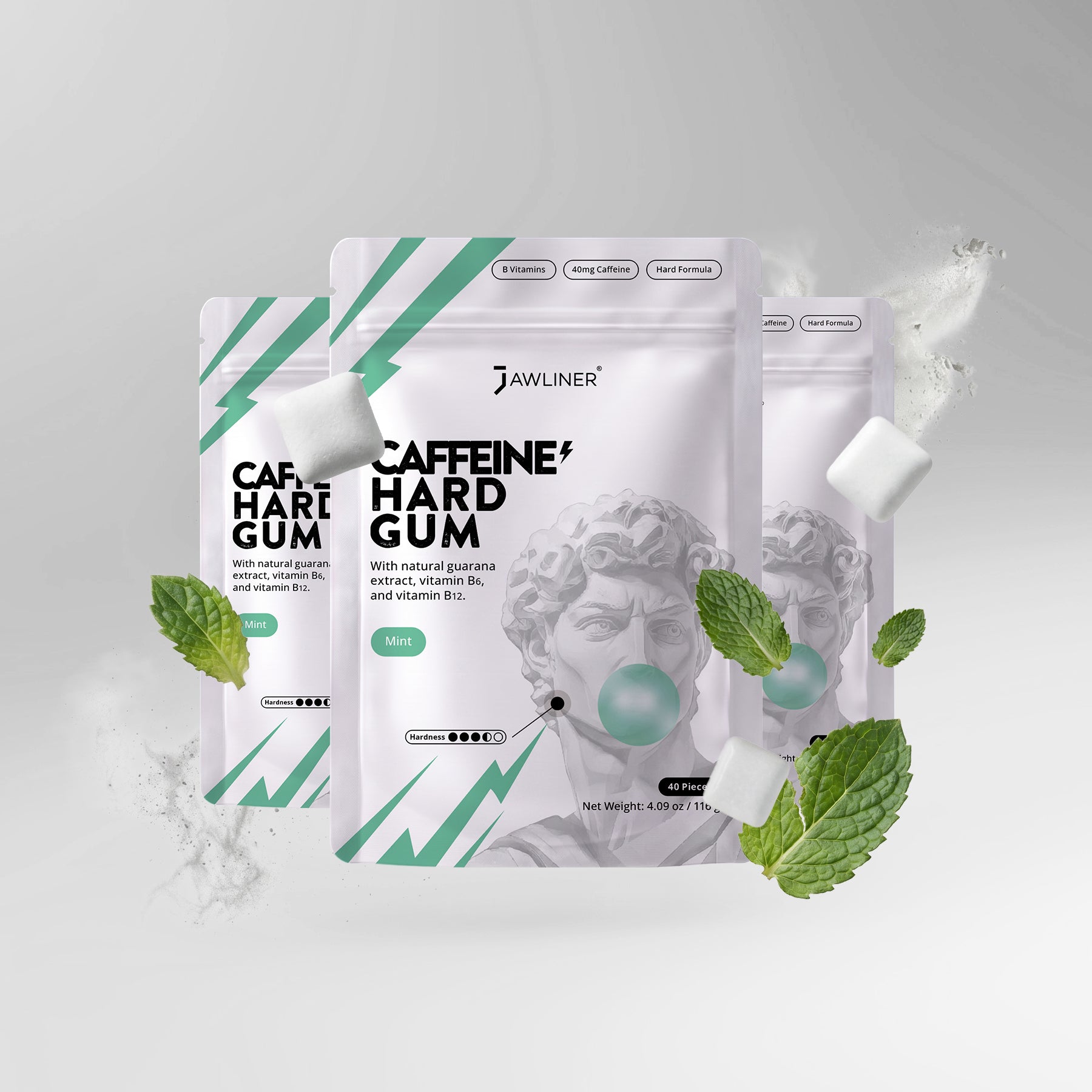
But it can also work faster. Through the oral mucosa, caffeine enters the bloodstream directly, bypassing the digestive tract. That’s exactly what the JAWLINER Chewing Gum Hard with Caffeine is designed to do. It delivers 40 mg of natural caffeine from guarana extract, plus vitamins B6 and B12, and you chew it right before your warm-up instead of an hour beforehand.
A practical bonus: There’s nothing in your stomach. Anyone who’s ever done squats with half a liter of pre-workout in their stomach knows why that’s a selling point.
Coffee, pre-workout, capsules, or gum?
All paths lead to caffeine, but they differ significantly in terms of dosing, speed of absorption, and tolerability.
- B CoffeeB is affordable, readily available, and socially acceptable. The downside: The dose varies considerably depending on the beans and preparation method, and not everyone can handle it on an empty stomach.
- Pre-workout boosters deliver a lot of caffeine plus, in most cases, a whole list of ingredients. That’s exactly the problem, because 300 mg or more is too much for many people—it makes you jittery and ruins your sleep if you work out in the evening.
- Caffeine capsules can be precisely dosed and are tasteless, but they take a while to kick in and can feel quite intense for some people.
- Caffeine gum offers the most precise dosage available. It works quickly, has no calories, and doesn’t sit heavy in the stomach. With JAWLINER Caffeine Gum, you get two benefits that no other pre-workout offers. First, when lifting heavy weights, you have something between your teeth to bite down on instead of clenching your teeth together. Second, the gum is intentionally hard, which helps train your chewing muscles as well. You can read more about how this training works in our article on the science behind Jawline Training.
An important note on usage: The hard gum is a training tool for your jaw. Stick to 10 to 15 minutes and take a one-day break between chewing sessions to allow your muscles to recover. These few minutes before your workout are more than enough to get the caffeine kick.
Caffeine Effects with Guarana Instead of Synthetic Caffeine
Many labels simply list “caffeine,” which is often synthetically produced. In JAWLINER Caffeine Gum, it comes from guarana, a vine native to the Amazon region whose seeds are among the most caffeine-rich plant parts in existence.
The difference lies less in the molecule itself—after all, caffeine is caffeine. What’s interesting is the packaging around it. In guarana, the caffeine is embedded in a plant-based matrix containing tannins, from which it tends to be released somewhat more slowly than from pure caffeine powder. Many therefore describe the effect as smoother and less abrupt.
Caffeine and Sleep: The Half-Life
The most commonly underestimated factor. In healthy adults, caffeine has a half-life of about 3 to 5 hours. If you take 200 mg at 6:00 p.m., about half of it will still be active by 10:00 p.m.
How quickly your body metabolizes caffeine depends, among other things, on your genetics, which is why some people can drink an espresso in the evening and still fall asleep. A more reliable rule of thumb is: no more caffeine in the last 6 to 8 hours before bed.
For evening workouts, this leads to a simple conclusion: it’s not the substance that’s the problem, but the amount. 40 mg has a significantly milder effect than a 300-mg booster. If you train after work at 8 p.m., you’re better off with the smaller dose.
Common Mistakes
- Starting with too high a dose: If you go straight to the maximum dose, you’ll feel jittery instead of focused.
- Taking it too late: A capsule taken five minutes before your first set won’t kick in until you’re done.
- Taking the same amount every day: Your body gets used to it, and the effect wears off. Use caffeine strategically for tough workouts, not out of habit.
- Relying solely on caffeine: Sleep, food, and hydration have a much greater impact on a workout than any booster.
- Taking too much on an empty stomach: If you have a sensitive stomach, this can quickly lead to nausea and heartburn.
Frequently Asked Questions About Caffeine Before Exercise
Note
This article is for general information purposes only and is not a substitute for medical advice. High caffeine content: not recommended for children or pregnant or breastfeeding women.


