



In the world of facial aesthetics we tend to focus on what we see in the mirror: the skin, the bone structure, the symmetry. What gets overlooked is the most powerful tool we have for changing how we look, and that is functional movement. For decades the focus sat entirely on topical treatments, but modern science and pioneers like Dr. Mike Mew have shown that the secret to a defined jawline sits deeper, in the chewing system itself.
Chewing does more for your jawline than almost any other facial exercise. What matters is intensity, resistance and technique. This guide walks through the science of active chewing, the three techniques the community actually argues about, and what stays realistic once your growth phase is over.
The Modern Problem: Why Our Jaws Are Weak
Anthropologists have documented a clear shift in human facial structure over the last few centuries. As we moved from hard, fibrous foods to processed, soft alternatives, our jaw muscles started to atrophy. That lack of mechanical load is associated with narrower faces and less pronounced jawlines.
Active chewing reverses the trend by putting the resistance back in, the kind our ancestors dealt with every day. Chewing hard sends a signal that the facial muscles and the bone they attach to need to handle load.
Dr. Mike Mew’s Take on Active Chewing
As the leading figure behind mewing, Dr. Mike Mew argues that tongue posture provides the internal support for the face while hard chewing provides the external scaffolding. Without strong masseter muscles the face lacks the structural stimulus it needs to stay broad and defined. Dr. Mew’s position is that the modern face is often underdeveloped simply because we no longer chew enough to trigger the bone remodelling process known as Wolff’s law.

Putting that into practice comes down to two strategies. First, switch to firm, fibrous foods that actually require force to break down. Second, use the big bolus method: chew a large mass of tough gum and move it across your palate with your tongue. That trains the jaw and the tongue at the same time.
Forward Chewing: The Direction You Chew In
In the mewing and orthotropics community you will run into the term forward chewing constantly, usually next to forward growth. It is not about how often you chew. It is about how.
What forward chewing means
In ordinary chewing the lower jaw mostly travels up and down. In forward chewing there is a forward component: as you bite down, the lower jaw pushes slightly ahead, the way it does naturally when you break down tough, fibrous food. Soft food never demands that movement, which is why most people have lost it.
Which teeth you chew with
If you only grind on your back molars, you are using a fraction of your chewing system. The orthotropics school recommends bringing the food across your incisors and premolars too, so the work happens further forward in the mouth. In practice: bite with your front teeth instead of shoving everything straight to the back. With hard gum you can drill the same pattern by deliberately working the mass between your front and middle teeth rather than crushing it at the back.
Why bilateral chewing matters
Most people have a preferred side and never notice it. Over years that produces a visible difference between left and right, because the masseter on the favoured side gets more stimulus. The gym rule applies here too: load both sides equally. Switch sides every set, or work with two pieces of gum at once, one on each side.
Does chewing actually cause forward growth?
This is worth separating carefully.
During the growth phase, in childhood and adolescence, the influence of function on facial development is orthodontically accepted. Breathing, tongue posture and chewing load act on a system that is still growing.
In adults the picture is different. There is no evidence that chewing or tongue posture still moves the maxilla forward. What does measurably change in adults is the chewing musculature. The masseter responds to resistance like any other muscle, and that is what visibly changes the width and contour of the lower third of your face.
Forward chewing still matters for you. Not as a route to a new bone structure, but as a training detail: spreading the force across the whole chewing system instead of grinding at the back recruits more muscle and keeps you symmetrical.
The Science: How Chewing Sharpens Your Jawline
Active chewing drives hypertrophy of the chewing muscles. Three effects work together.
First, masseter hypertrophy. Like your biceps, the masseter grows under load and gives the gonial angle a broader, more defined look.
Second, a sharper border to the neck. A stronger masseter makes the gonial angle read more clearly, which sharpens the line between face and neck. What chewing does not do is remove fat under the chin; that is a separate lever, and it is covered further down.
Third, bone stimulation. The steady pressure of chewing acts as a mechanical stimulus on the bone where the chewing muscles attach. It will not move the position of your jawbones in adulthood, but the prominence of the gonial angle and the surrounding musculature is another matter.
How to Hard Chew: The Step by Step
Hard chewing is not all-day chewing. It is resistance training with sets, rest and an end point. Eight hours of soft gum trains nothing and invites problems. Ten minutes against real resistance creates a stimulus.
Step 1: Warm up. Chew slowly and loosely for one minute until the mass is warm and pliable. Never bite into a cold, hard piece at full force.
Step 2: Pick your resistance. Supermarket gum is too soft to create a training stimulus. Our jawline chewing gums come in several hardness levels so you can start low and progress.
Step 3: The set. Three minutes slow and controlled, then two minutes faster but still controlled. Then five minutes rest. Controlled means you drive the movement rather than slamming through it.
Step 4: Both sides. Switch sides after every set, or work two pieces at once, one left and one right. Symmetry does not happen on its own.
Step 5: Duration and frequency. Ten to fifteen minutes per session, three to four times a week, with at least one rest day in between. Same as any other muscle group.
Step 6: Stop if. Pain in the jaw joint, clicking, headaches or tightness around the temples mean stop. That is overload, not progress. If you already have TMJ issues or grind your teeth at night, clear the training with your dentist first.
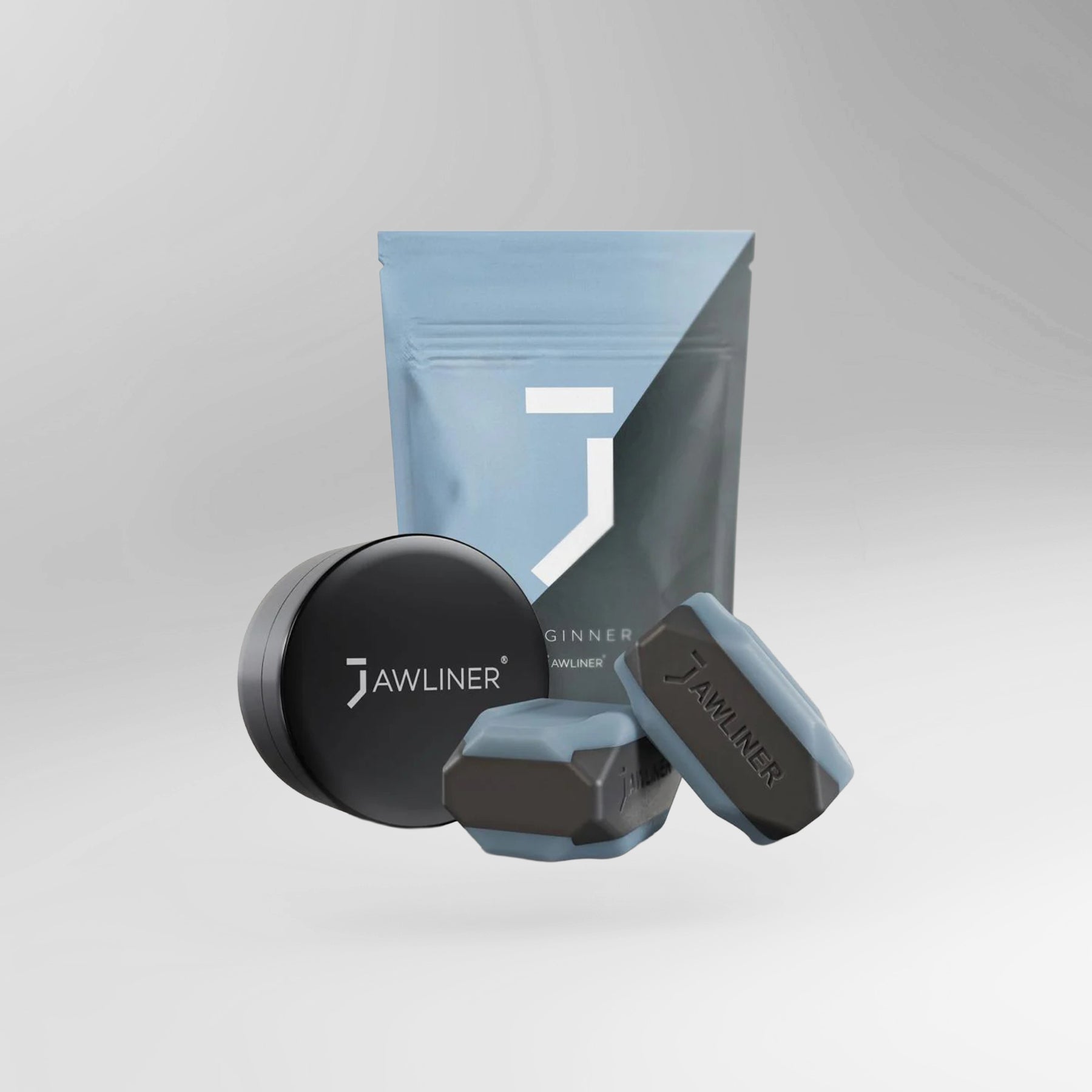
If you would rather work with a device than with gum, the JAWLINER® 3.0 applies the same logic through interchangeable resistance levels. Jaw exercises without any equipment work as a warm-up on top of that.
Tongue Chewing: The Next Level Technique
To get the most out of your training, Dr. Mew recommends a technique called tongue chewing. Unlike normal chewing, where only the teeth do the work, this one recruits the tongue.
How to tongue chew
Take the gum onto the tip of your tongue, press it flat against your palate, then push it backwards across the palate using your tongue alone, without letting your teeth touch it. The gum stays between tongue and palate the whole time. Bring it forward again and repeat.
What tongue chewing actually does
It trains the tongue musculature, not the masseter. A stronger tongue holds the resting position against the palate more easily, and that position is the core of mewing. So tongue chewing is not a replacement for hard chewing, it is the complement to it. If you want to lock the tongue position into your day as well, the mewing ring is built for that, and our guide to what mewing is and whether it really works covers the wider picture.
Tongue chewing vs bolus chewing
In bolus chewing you work a large mass back and forth between teeth and tongue. Tongue chewing skips the teeth entirely. In a single session you can run both: a few sets of hard chewing for the masseter, a few minutes of tongue chewing for the tongue.
One thing people miss: if you breathe through your mouth at night, you spend eight hours working against everything you trained during the day. Our mouth and nose tapes are made to support nasal breathing while you sleep.
What Results Look Like, and When
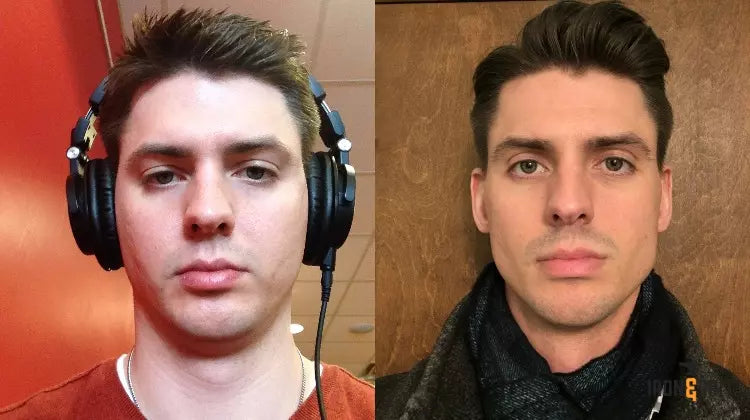
Photos in the community can be misleading, because lighting and camera angle do a lot of the work. Here is the honest timeline.
Weeks 1 to 3: You will feel it before you see it. Soreness in the masseter after a session is normal in the first weeks.
Weeks 4 to 8: First visible changes for most people, usually noticed by others before you notice them yourself.
Month 6 and beyond: A clearly more defined gonial angle in most cases, assuming you trained consistently and took rest days.
Two things training cannot do: change your bone structure, or remove fat from a specific area. If a layer of facial fat is sitting over the muscle, the definition stays hidden regardless of how hard you chew. That side of the equation is covered in our guide to losing facial fat, and what bone structure decides on its own is the subject of hollow cheeks.
If you want to track progress properly, take a photo every four weeks in the same light, at the same angle, with a neutral expression. Daily mirror checks tell you nothing.
The JAWLINER® Advantage: Training for Results
The theory of active chewing is simple. Execution usually fails on the material. Regular gum is built for flavour and fresh breath, not for muscle growth. To see real change in your jawline you need resistance that ordinary gum cannot provide.
That is why we built JAWLINER® Fitness Chewing Gum. It is considerably harder than conventional gum and delivers the resistance masseter hypertrophy requires. Because it is that tough, you do not need to chew for hours. One focused session of ten to fifteen minutes, three to four times a week, is enough.

It is vegan and sugar-free. If you are serious about your jawline, it is time to stop chewing for flavour and start chewing for results. Shop the full JAWLINER® collection.
Chewing and Jawline FAQ
Note
This article is general information and does not replace medical or dental advice. If you have jaw joint problems, grind your teeth, or have any pre-existing condition, speak to a doctor or your dental practice before starting.


