




Good evening, salty food, and the next morning your face looks fuller than usual. Smaller eyes, a softer jawline. That is not your imagination and it is not weight gain. It is water, and it leaves as quickly as it arrived. Here is what happens in between.
What Happens After a Salty Meal
Sodium, the main component of table salt, binds water. When the sodium concentration in your blood rises, your body holds on to more fluid to balance it out. That is not a fault, it is regulation: the body keeps its salt concentration inside narrow limits and uses water as the buffer.
The counterweight is potassium. The two minerals work as a pair, and what matters is not the absolute amount of salt but the ratio between them. For most people that ratio tips heavily towards sodium, because processed food delivers a lot of salt and very little potassium.
The Timeline: From the Meal to the Mirror
How fast it shows surprises most people:
- After one to two hours: thirst. That is the first signal that the concentration in your blood has gone up.
- Overnight: the fluid spreads through the tissue. Because you are lying down, it collects where the connective tissue is loose, and in the face it is.
- The next morning: the visible peak. It is strongest right after you get up and fades through the morning once you are upright and moving.
- After one to two days: back to normal, assuming you drink enough and the next salt bomb does not follow immediately.
Take a photo in the morning and another in the evening and the difference is usually clearer than in the mirror. What to watch out for is in our guide to being photogenic. There is more on that effect in our guide to a puffy face.
Why It Shows Up in Your Face First
Two reasons. First, the skin on your face is thinner than elsewhere and the connective tissue underneath is looser, especially around the eyes. Retained fluid shows there before anywhere else. Second, you lie down at night, and fluid follows gravity. During the day it travels down into legs and feet, at night it redistributes towards your head.
That is why your face is fuller in the morning and your ankles thicker in the evening. Same water, different time of day.
What Helps and What Does Not
The effective part is unspectacular:
- Drink: it sounds contradictory, but it is the core of it. Short on fluid, the body holds on to what it has. Two to three litres across the day give it no reason to.
- Potassium from food: potatoes, bananas, legumes, spinach, avocado, dried apricots and nuts. One serving of those does more than giving up the salt shaker entirely.
- Movement: a walk in the morning gets the circulation going and redistributes the fluid faster.
- Start the evening before: the meal before bed decides how your face looks in the morning, not breakfast.
What does little or nothing: water pills from the pharmacy are medicines and belong in a doctor's hands, not in a morning routine. Sauna to the point of dehydration just moves the problem. And cutting salt out completely is neither necessary nor sensible, because sodium is an essential mineral.
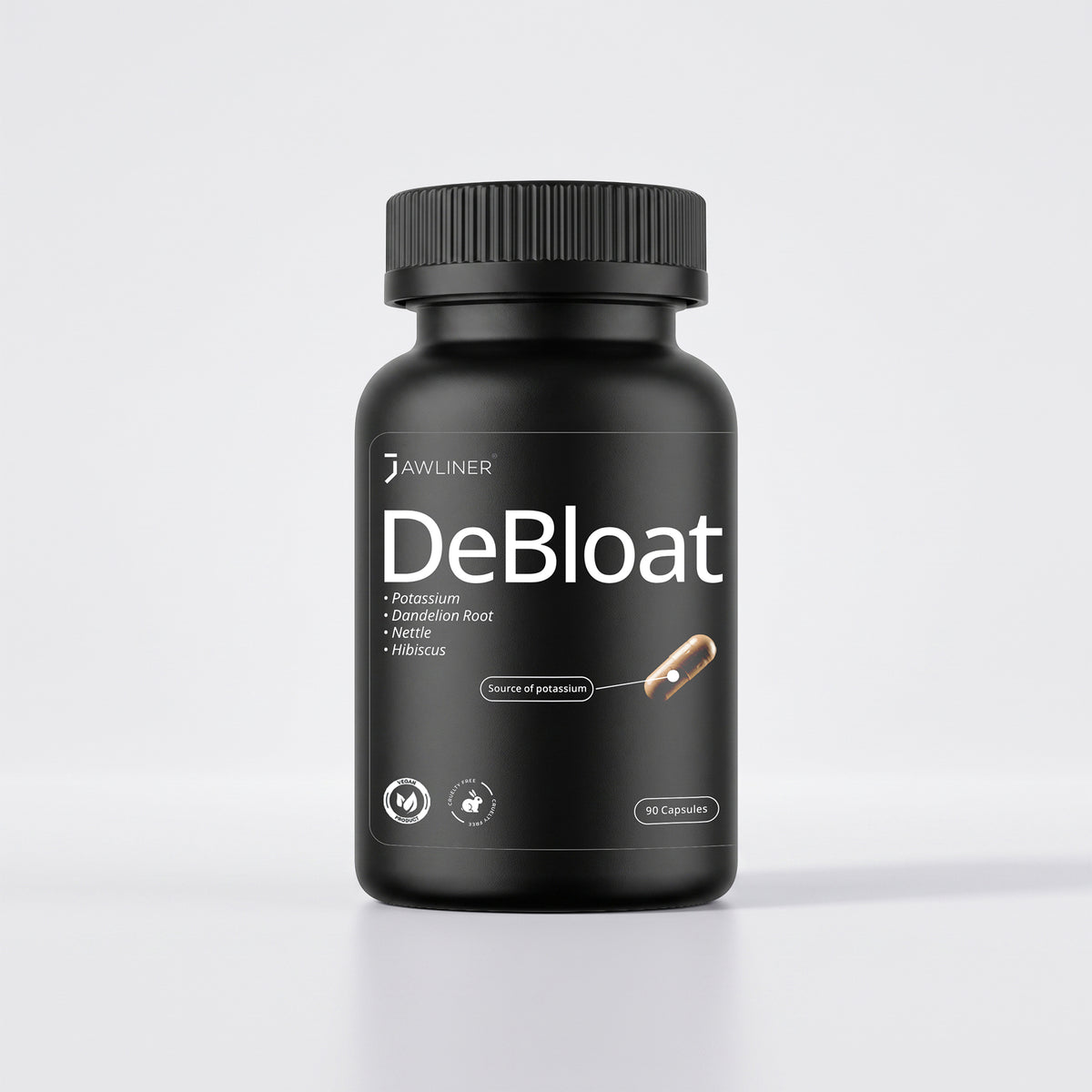
If you want potassium from a capsule on top of your food, there are 500 mg per serving in our JAWLINER DeBloat capsules. Potassium contributes to normal muscle function.
How Much Salt Is Actually Too Much?
The WHO recommends a maximum of five grams of table salt a day for adults, roughly a level teaspoon. Actual intake sits well above that for most men.
The shaker on the table is rarely the problem. Most of it is already in processed food:
- Bread and baked goods: the largest source by volume, simply because people eat a lot of it.
- Cold cuts, ham, cheese: high salt density per portion.
- Ready meals, pizza, sauces, snacks: often several grams in a single meal.
- Restaurant and delivery food: as a rule salted more heavily than what you cook yourself.
In practice: cooking for yourself on two or three days a week shifts the balance more than any restraint at the table.
When It Is Not the Salt
A fuller face in the morning does not always come from dinner. Alcohol, too little sleep, stress and certain medications act on the same mechanism. Creatine gets blamed too, but it works differently. Whether a changed face is water or fat can be told from the timeline: water comes and goes within days, fat changes over months. The full distinction is in our guide to face fat versus water retention.
See a doctor in three cases: when the swelling is one-sided, when it comes on suddenly together with breathing difficulty, a rash or tightness in the throat, and when it stays for days with no change in diet or sleep to explain it. Persistent fluid retention can point to the kidneys, the heart or the thyroid and should be checked.


